Flow is Order: What Tencent’s Migration Data Reveals About the Future of Smart Cities
May 12, 2026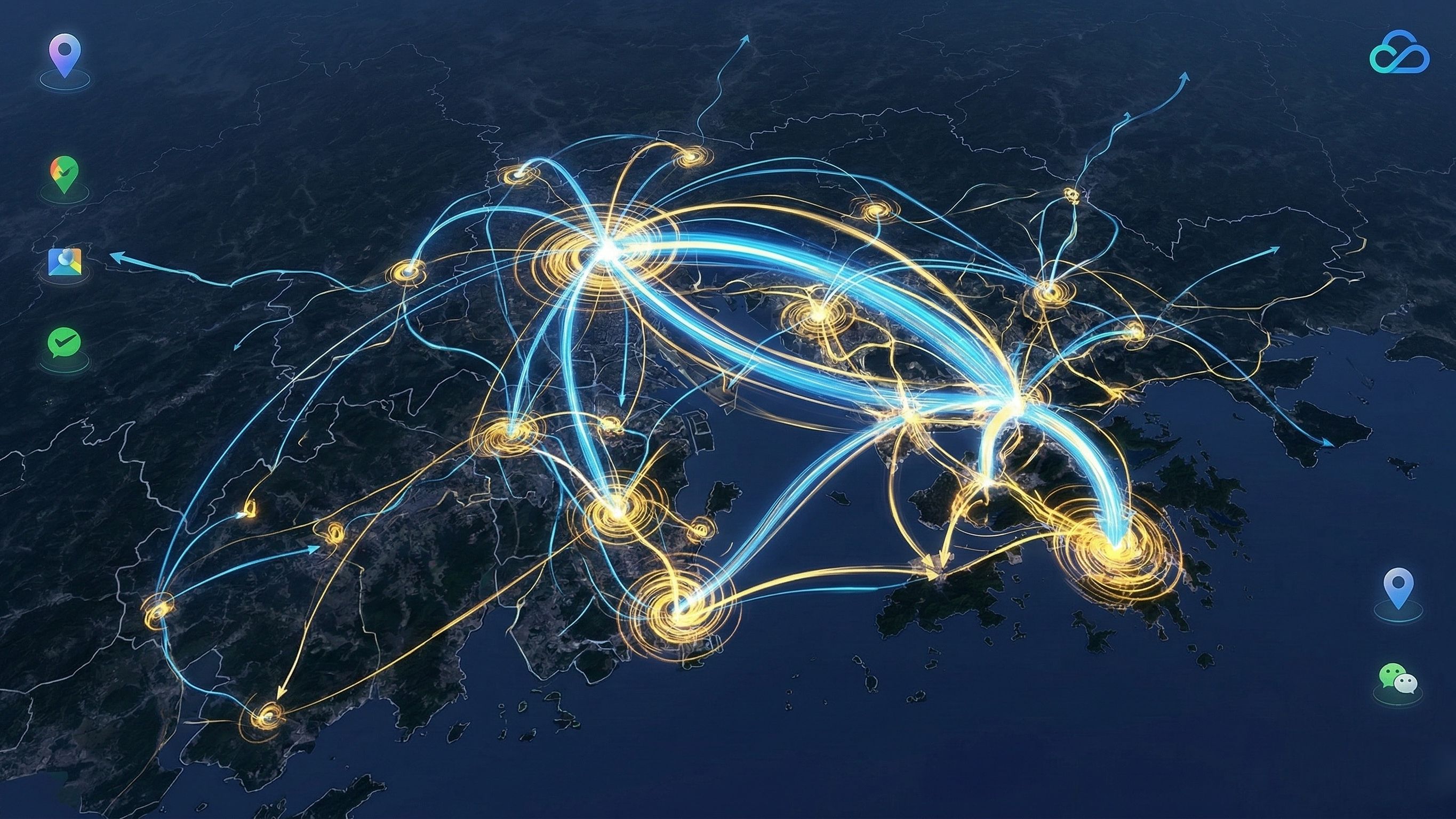
By analyzing the movements of over one billion people, Tencent has redefined urbanization not as geography, but as a "Spatio-temporal Flow Network". Tencent's human mobility network data proves that moving populations act as the engine of innovation, with digitally-coordinated mobility replacing static centralization. In the digital era, economic resilience grows as social mobility increases, transforming migration from a geographic problem into a vital social systems indicator.
From Settled Societies to Mobile Societies For decades, urban studies equated modernization with stability and centralization. However, Tencent’s migration research across China reveals a new reality for the digital age: mobility, distribution, and networks are the true foundations of order.
Urban growth is no longer defined strictly by physical borders, but by "mobility hubs"—the intersections of flow. By modeling anonymized data from WeChat, Maps, and Payments, Tencent visualizes social order in real-time.
The Three Metrics of Networked Urbanization Instead of merely counting populations moving from point A to point B, Tencent's algorithms measure connection strength, directionality, and persistence. This yields three critical macroeconomic indicators:
- Flow Density: Measures the strength of a city’s external connections and economic vitality.
- Stickiness Coefficient: Evaluates how strongly residents remain socially attached to a specific location.
- Elasticity of Flow: Assesses how quickly a city recovers from systemic shocks like pandemics or economic downturns.
The Economic Logic of Mobility Tencent's data reveals that in the digital era, migration is the engine of innovation. For instance, the Greater Bay Area relies on "cross-boundary integration," forming an ecosystem of inter-institutional collaboration in talent and capital. Furthermore, post-pandemic data exposed a "psychological migration," where second and third-tier cities experienced surges of returning talent, shifting the tech industry toward a distributed innovation network.
The Strategic Takeaway Data flows are the memory of modern civilization, and mobility networks are its nervous system. Understanding digitally-coordinated mobility is essential for global leaders seeking to build adaptable, resilient economic systems.
Want to decode the data systems and hidden operational strategies behind China's most powerful tech enterprises? Master these high-impact frameworks with the Garbo Decodes China masterclass at the Global Education Institute.