The Ultimate M&A Masterclass: What Modern CEOs Can Learn from China's First Emperor
Mar 19, 2026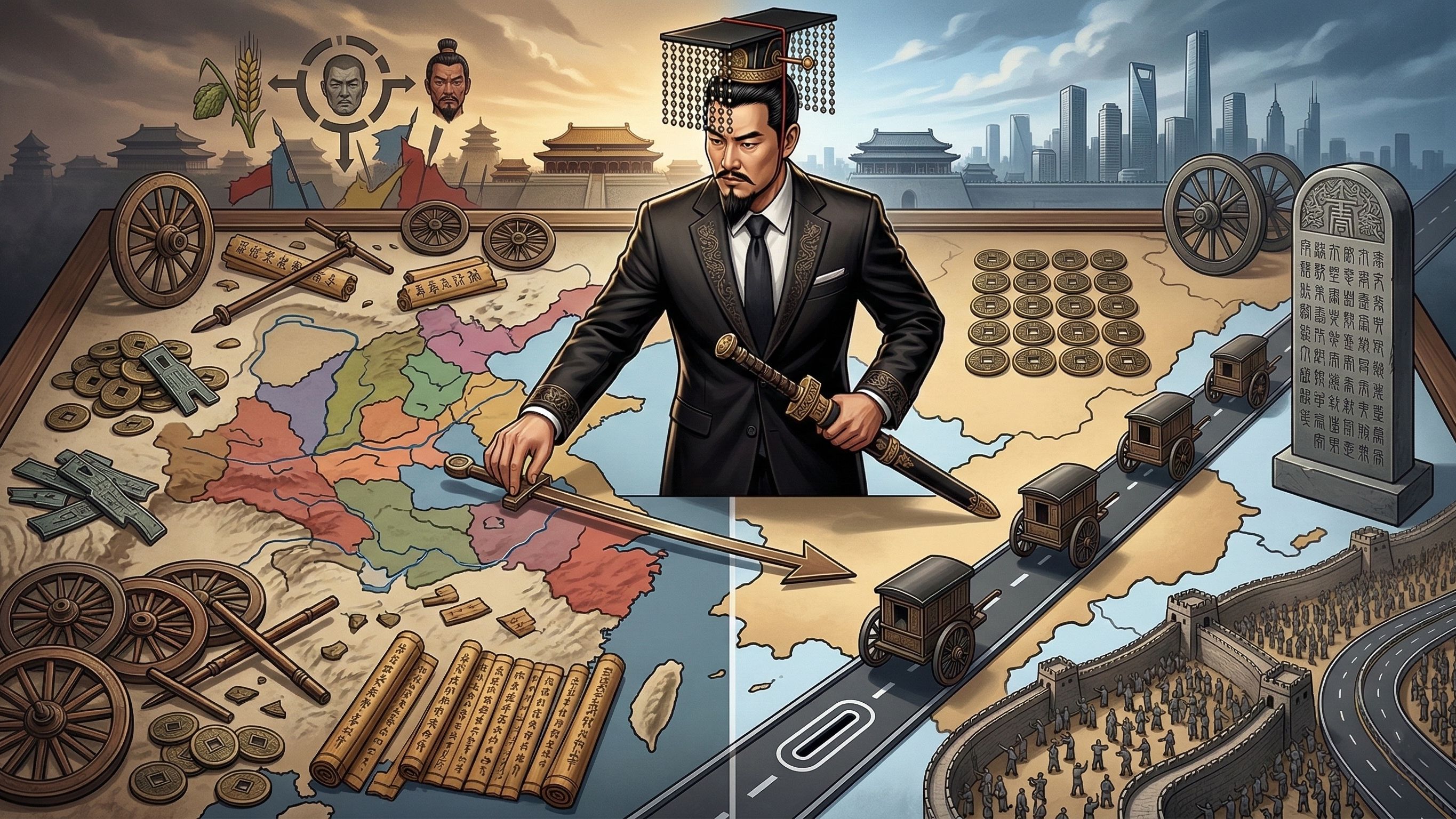
In business school, we often study "M&A" (Mergers and Acquisitions) through the lens of modern tech giants or financial conglomerates. But imagine for a moment: what if this wasn't just a merger of two companies, but the forceful integration of seven "super-conglomerates"—each with different cultures, different currencies, and even different languages? To decode the secrets of Post-Merger Integration (PMI), we must look back to 221 BC and study the most ruthless "Merger Maniac" in human history: Qin Shi Huang.
Executive Summary
- The Catalyst: Anyone involved in M&A knows that buying a company is the easy part; Post-Merger Integration (PMI) is the true nightmare. When Qin Shi Huang conquered six rival states, he inherited a massive mess of fragmented infrastructures and skyrocketing transaction costs.
- The Mechanism: To prevent the newly merged empire from fracturing, he executed a strategy of "Forced Standardization". He violently eliminated differences across physical logistics, data protocols (language), and currency.
- The Strategic Edge: By unifying the "interface" of the empire, he successfully built a platform for Economies of Scale, drastically lowering transaction costs and creating the largest single market on Earth at that time.
The Myth of the Seamless Merger
When Qin Shi Huang took over the State of Qin, China was in the "Warring States Period". You can view the market at that time as a total addressable market partitioned by seven giant corporations, each trying to liquidate the others. The State of Qin won the initial "market share" using an extremely brutal but highly efficient KPI assessment system known as "Farming and War" (Geng Zhan). In this data-driven society, promotion was strictly tied to either agricultural output or severing enemy heads on the battlefield.
However, after bulldozing the competition in just ten years, the real challenge began. The emperor faced a fragmented landscape where road widths, weights, measures, and writing systems varied across the conquered territories. If a merchant wanted to ship goods across this new empire, they had to switch currencies, scales, and languages at every checkpoint. In the terms of Nobel Laureate Ronald Coase, these differences meant astronomically high Transaction Costs.
Actionable Framework: The 3-Point Standardization Matrix
To solve this, Qin Shi Huang made his greatest decision as a CEO: Forced Standardization.
- Physical Infrastructure (The "USB-C" Mandate): He implemented "Che Tong Gui" (Carts with the same track). Because wheel spans previously differed across states, carriages couldn't move if their axles didn't match the ruts in the dirt roads. He mandated a unified wheel span of six feet for all carriages. This is exactly like the European Union mandating that Apple must use the USB-C port—once the interface is unified, logistics efficiency explodes.
- Data & Protocol Standards: He executed "Shu Tong Wen" (Books with the same script). By abolishing the complex writing systems of the six conquered states and mandating a single national font (the Small Seal Script), he ensured that administrative orders and commercial contracts could be interpreted without error anywhere in the empire.
- Unified Currency: He abolished the chaotic mix of knife-shaped and spade-shaped regional money. In its place, he designed the "Qin Ban Liang," a standard copper coin that remained the currency form in China for the next two thousand years.
Deep Dive Q&A
Q: What was the ultimate economic result of this forced standardization? Scale is the primary motive force of business, and standardization is the prerequisite for scale. By violently eliminating differences, Qin Shi Huang created the largest Single Market on Earth at that time. With transaction costs at historical lows, he was able to mobilize millions of people for mega-projects, including the Great Wall and a 700-kilometer superhighway.
Q: If the integration was so successful, why did this "super-company" collapse? The Qin Empire collapsed after just 15 years. The fatal flaw was that Qin Shi Huang only unified the "Hardware" (roads, money, and text). He attempted to use draconian laws to format the "Software"—the minds and culture of the people. Due to extreme oppression, he failed to find a sustainable way to operate the empire, and it was ultimately burned to the ground by peasant uprisings.
The world is noisy, and daily headlines about the Chinese market are filled with myths, extreme narratives, and misconceptions. As a decision-maker, you cannot afford to rely on second-hand opinions.
That is why the Global Education Institute has officially launched our flagship Mini-MBA program: The Dragon’s Ledger: 2000 Years of Chinese Business Logic.
Designed exclusively for global game-changers, this course will empower you to:
- Decode the DNA: Understand the "Big Government, Small Market" source code established during the 81 BC Great Debate on Salt and Iron.
- Navigate the Golden Age: Uncover the inflation lessons behind the world's first fiat currency (Jiaozi) and the early separation of ownership and management during the Song Dynasty.
- Master the Cycles: Grasp the "Pendulum of Power" to accurately predict the opening and tightening cycles of the Chinese market.
- Understand the Culture: Discover why Chinese entrepreneurs are eternally bound to the concepts of "Land" and "Economic Nationalism."
In your final Capstone Project (Lesson 30), you will step out of the spectator's seat. Armed with 5,000 years of insight, you will personally design and pitch a comprehensive market-entry strategy.
Understand the past to embrace the future. Only by truly stepping into the ebb and flow of this ancient civilization can you build your own independent judgment in an ever-renewing market.
[Enroll in "The Dragon's Ledger" Mini-MBA Now] Unlock the historical frameworks quietly shaping tomorrow's global business.