The Turing Test of the Chinese Lunar New Year
Feb 10, 2026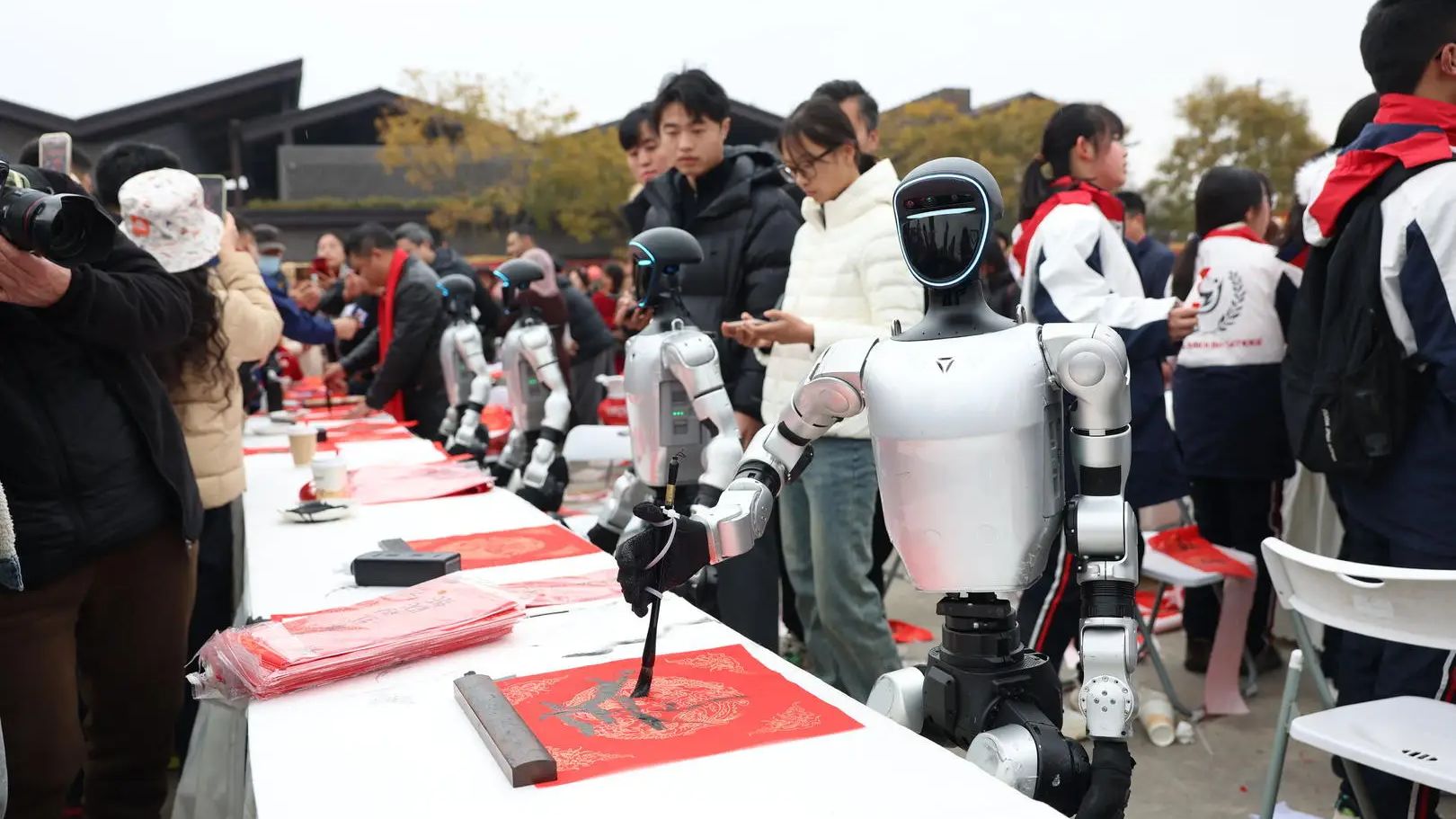
The Turing Test of the Chinese Lunar New Year
This is no longer a celebration—it’s a system stress test at the scale of 1.4 billion users.
This week, China is running the largest social beta test in human history.

On one screen, I see the traditional Chunyun—the Spring Festival travel rush. This is the computational limit of carbon-based life. Hundreds of millions of anxious, eager, exhausted individuals attempt to complete physical migration within 72 hours. Even with high-speed trains, the air is thick with a sense of “system overload.” We still crash trying to grab tickets, lose sleep under relatives’ questioning, and expend all our energy to maintain the dignity of the New Year’s Eve dinner. The human Spring Festival is high-entropy, chaotic, and full of friction.
But on another screen, I see a preview of the “new order.”
In the squares of first- and second-tier cities, thousands of drones weave dragons in the night sky with millisecond-level precision;
robotics companies—some yet to launch commercially—crowd into sponsoring the Spring Festival Gala, watched by Chinese audiences worldwide;
in crowded tourist spots, humanoid robots attract attention amidst the throngs, replacing humans.
The contrast is both brutal and mesmerizing. Humans embody the warmth and chaos of the old world. Machines embody the cold order of the new.
What does this mean for us?

Anthropologically, extreme scenarios have always been used to test systems. Normal conditions hide flaws; stress exposes structure.
On one screen, I see the traditional Spring Festival: the crowds of Chunyun, the tension of family relationships, the buildup and release of emotions. Society relies on human understanding, patience, and compromise to barely maintain stability. This is an ancient mechanism—and a costly one. Stability is not designed; it is endured.
On the other screen, a completely different order emerges. Drones coordinate with millisecond-level synchronization; robots maintain rhythm even in the densest spaces; algorithms allocate paths, timing, and resources behind the scenes. These systems neither understand reunion nor participate in emotion, yet they perform most reliably at the moment when emotion peaks.
This juxtaposition brings the Spring Festival closer than ever to the original spirit of the Turing Test.
The Turing Test does not ask whether machines truly “think like humans.” It asks whether, functionally, humans can no longer distinguish them. New Year’s Eve asks the same question: when a society nears overload, can we still tell which behaviors are human and which are system responses?
The Spring Festival is a sociological “edge scenario.” Here, human emotion ceases to be lubrication and becomes noise; social ties cease to be bonds and become friction; experience ceases to be an advantage and becomes an unreplicable burden. The operation of society begins to reveal a fact: its demand for stability now exceeds what individual humans can sustainably provide.
In this sense, “renting robots” is no longer a technological topic—it is a metaphor for institutional design. It points to a new social arrangement: when stability becomes a first-order requirement, must it remain embedded in humans, or can it be externalized, modularized, and deployed on demand?
The Spring Festival does not require machines to feel; it requires execution unaffected by emotional fluctuations. Under high load, society does not reward understanding—it rewards predictability. This is not a value judgment; it is a structural choice.
Thus, the Spring Festival is not the opposite of tradition—it is a trial run of future society. In this scenario, society is testing a new hypothesis: can order be maintained without relying on human self-expenditure?
The New Year’s Eve Turing Test is not about machines passing.
It is the moment we first realize that, when society is pushed to its limits, the beings most “human” are no longer humans themselves.
