The Great Rewiring
Issue Date: February 2, 2026 – February 8, 2026
Keywords: Financial Powerhouse Strategy,Expanding Import Strategy,Gradient Cultivation,Brain-Computer Interface, Embodied Intelligence,Future Industries, Patient Capital, Drifting from the Real to the Virtual
Weekly Message
In the first week of February 2026, global capital markets underwent a profound cognitive restructuring and a reshuffling of their underlying logic. When Western markets were thrashing about for direction amid sticky inflation, geopolitical fragmentation, and marginal adjustments to monetary policy, Chinese policymakers fired off a dense volley of strategic signals designed to recast the macroeconomic foundations of the next decade. Market dynamics emanating from China this week suggest that a novel economic paradigm—driven by the dual engines of a "financial powerhouse strategy" and the "layout of future industries"—is coalescing at breakneck speed. This is supplemented by an "expanding import strategy" that serves as a flexible moat to maintain the stickiness of global supply chains. For Western institutional investors hunting for cross-border arbitrage, multinational corporate strategists, and macro hedge fund managers, a profound comprehension of this complex paradigm's internal anatomy is a prerequisite for navigating geopolitical friction and securing outsized returns in the dawn of a new long-wave economic cycle.
The core threads of this week’s developments converge upon two macroeconomic dimensions that appear discrete but are, in fact, highly coupled. First, the 24th collective study session of the Political Bureau of the Chinese Communist Party Central Committee in late January, and a subsequent heavyweight article published in Qiushi magazine concerning the "modern financial system with Chinese characteristics," explicitly demarcated the new role and boundaries of capital in the second half of China’s economic ascent. Within this narrative, finance cannot be a virtual game of self-perpetuating prosperity and short-term arbitrage divorced from the real economy; rather, it is strictly anchored as the foundational infrastructure serving "new quality productive forces". The highest echelons of policymaking made it abundantly clear that building a financial powerhouse requires accelerating the construction of six major systems and cultivating a financial culture with Chinese characteristics centered on being "honest and trustworthy, valuing righteousness over profit, being prudent and steady, maintaining fundamental integrity while innovating, and strictly complying with the law". This means that historical Western investment paradigms, which relied upon high leverage, regulatory arbitrage, or superficial business model innovation, have been rendered entirely obsolete in the Chinese market. Future capital flows will be coercively corralled towards hard-core technological domains of immense strategic value.
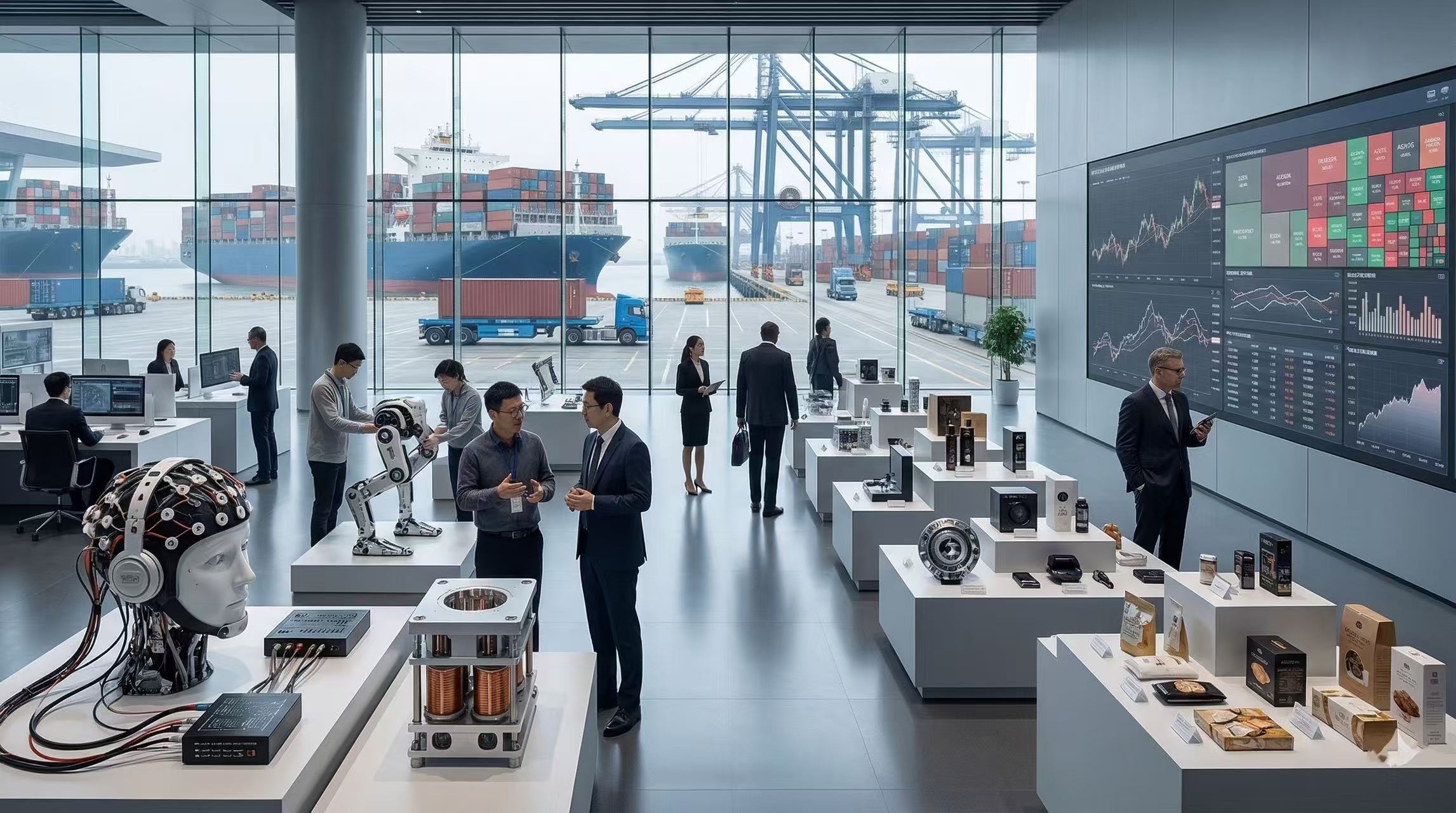
Second, on February 4th, China's Ministry of Commerce officially launched the "Sharing the Grand Market: Export to China" series of campaigns, announcing plans to host over one hundred diverse import-promotion activities in 2026. This marks the formal upgrade of China’s "expanding import strategy" from a defensive trade-balancing instrument to a proactive geoeconomic regulator designed to shape global commercial networks and hedge against unilateralism and protectionism. In 2025, the scale of Chinese imports reached a staggering 18.5trn yuan, retaining its position as the world's second-largest import market for the 17th consecutive year. Against a grim backdrop where the global trade friction index hovers at a dangerously high altitude, and where America dominates the deployment of restrictive trade measures, China is presenting the world with an asymmetric opening strategy of extraordinary foresight and cunning: seeking absolute, sovereign control over core technologies, while providing absolute, unfettered dividends in consumption and general trade.
At the intersection of these two grand national strategies, the traditional "time machine theory" of investment is undergoing a profound mutation and reversal. For the past three decades, the arbitrage logic of Western capital involved a "dimensional strike"—importing mature business models, technologies, and consumer goods from the developed world down into China. Today, China is attempting to execute leapfrog transitions beyond linear cycles in "future industries" such as brain-computer interfaces (BCIs), quantum technology, and embodied intelligence. Through "gradient cultivation" and a "new whole-of-nation approach," China hopes to establish immediate hegemony upon the technological high ground of the future, with the ultimate objective of reverse-exporting these standards and technologies back to the globe. Concurrently, on the consumption front, China is building a colossal import market, providing global brands with a spatial iteration of the time machine—leveraging China’s hyper-advanced digital commercial infrastructure to allow small and medium-sized overseas brands, currently trapped in stagnant domestic growth, to instantaneously acquire the market penetration necessary to reach hundreds of millions of middle-class consumers. This bilateral structural architecture—seeking reverse time travel at the technological frontier while offering an accelerated temporal conduit at the consumption terminus—constitutes the core cross-border arbitrage space within the contemporary Chinese market.
Consequently, this edition of The Niche Hunter will apply an exceptionally clinical and objective lens to deeply deconstruct this intricate and finely calibrated strategic combination punch. We will track the trajectory from the microscopic hardware of BCIs and cross-border commercial operating systems, up to the macroeconomic united investment fronts forged between state-owned capital and technology behemoths; from professional personas bearing distinct epochal characteristics, projecting forward to the capital safe-haven routing necessitated by escalating global trade frictions. For Western readers, the Chinese market has irrevocably evolved from a simple "world factory" or "consumption engine" into a super-entity that must be scrutinised through a granular, structured, and political-economic framework. Here, the intrinsic nature of capital, the generational progression of industry, and the directional flow of trade are all undergoing a radical redefinition.
Product Hunter
Under the dual macroeconomic narratives of "future industry layout" and "expanding import strategy," the core products emerging in the market this week are no longer mere symbols of consumption upgrading or isolated technological novelties, but rather technological carriers and commercial conduits laden with intense strategic metaphor. These products flawlessly embody the defining characteristics of new quality productive forces: high-growth potential, strategic importance, pioneering nature, and the capacity for disruptive recalibration of existing industrial paradigms. They serve as the most direct windows through which to observe China's technological leapfrogging trajectory and the vast digestive capacity of its domestic demand market.