Issue Date: April 13, 2026 - April 19, 2026
Key words: Beijing, Pedro Sánchez, Sheikh Khaled, To Lam, Daniel Francisco Chapo, Commercial Capital
Weekly Message
Dawn. A Beijing commuter, en route to work, astutely observes an anomaly at the city's operational nexus: Tiananmen Square is flying the national flags of three different countries simultaneously—an exceedingly rare occurrence. For ordinary citizens accustomed to the methodical, rigorously formal cadence of Chinese diplomacy, this "side-by-side hoisting" breaks with convention, signalling an international welcome of the highest specification unseen for quite some time. The commuter's intuition is unerringly precise—this week is indeed profoundly different.
Within the brief 168-hour window from April 13 to April 19, 2026, Beijing transformed into the ultimate crossroads of global geopolitics and commercial capital. Four foreign state leaders (and a crown prince), representing entirely distinct economic archetypes and strategic imperatives, paid intensive visits:
- Spanish Prime Minister, Pedro Sánchez Pérez-Castejón
- Crown Prince of Abu Dhabi, UAE, Sheikh Khaled bin Mohamed bin Zayed Al Nahyan
- General Secretary of the Communist Party of Vietnam and State President, To Lam
- President of Mozambique, Daniel Francisco Chapo
Product Hunter: Hardware Renaissance and the European Market
Focus: "What is selling? Where lies the next explosive inflection point in the technology stack?"
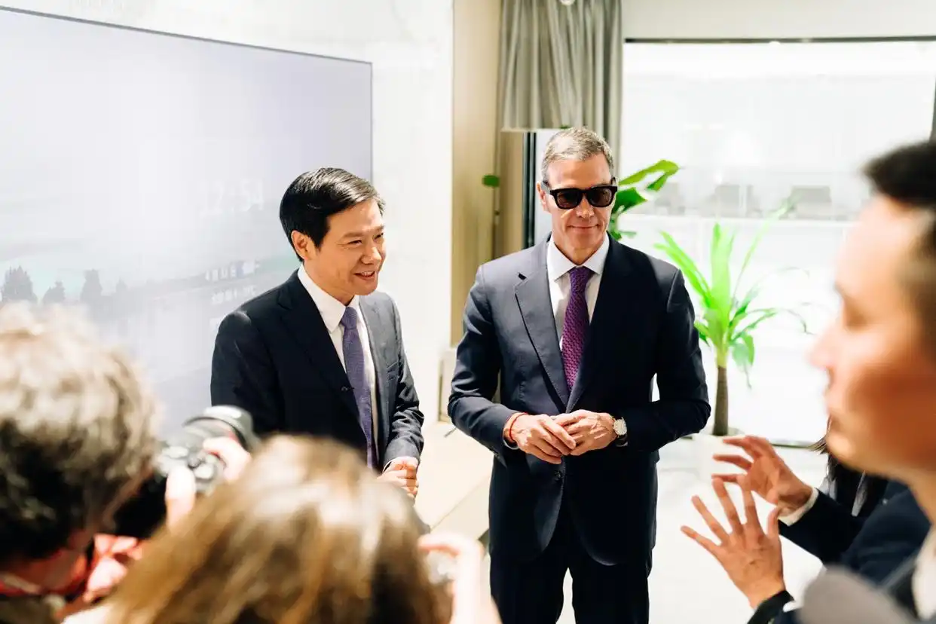
The week's most commercially monetisable micro-signal did not emerge from the Great Hall of the People, but rather from the Xiaomi Science and Technology Park in Beijing. On April 13, Spanish Prime Minister Pedro Sánchez, undertaking his fourth visit to China in four years, carved out time for a deep-dive inspection of the Chinese consumer electronics behemoth, Xiaomi. Accompanied by Xiaomi's founder, Lei Jun, Mr Sánchez not only toured the exhibition hall but personally test-drove the brand-new smart vehicle Xiaomi had just brought to market, and donned its latest AI smart glasses.
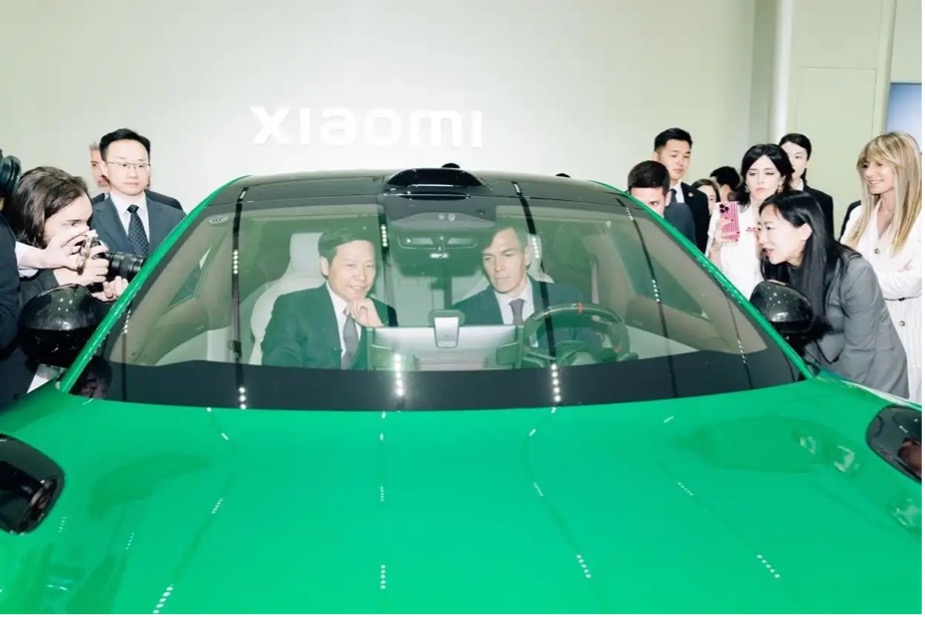
A head of state personally experiencing and implicitly endorsing a technology enterprise's hardware is a market signal of piercing clarity. This is not merely an endorsement of product prowess; it is a rehearsal for the comprehensive penetration of Chinese technological hardware into the European lifestyle.
Signal One: Smartphones on Wheels—The Xiaomi YU7's European Ambitions
Over the past three years, whilst the Western automotive industry has continued to agonise over "range anxiety" and "tariff barriers" for electric vehicles, the logic of Chinese automaking has undergone a dimensional leap. The automobile is no longer a mechanical product; it is a "smartphone with four wheels."
On-site, Mr Sánchez focused on Xiaomi's recently unveiled pure electric SUV—the Xiaomi YU7 and its high-performance iteration, the YU7 GT. The pricing strategy and performance metrics of this model have effectively backed traditional European luxury automakers into a strategic cul-de-sac.
Core Market Data and Specifications for Xiaomi YU7 |
Detailed Information |
Base Model Starting Price |
253,500 RMB (approx. 35,000 USD) |
High-Performance (YU7 GT) Powertrain |
Dual-motor drive, total output 990 HP (738 kW) |
Top Speed and Range |
Top speed 300 km/h, CLTC range 705 km |
European Market Strategic Pivot |
Spain (Xiaomi's smartphone market share in Spain reached 30% in 2025, ranking first) |
Estimated European Delivery |
2027 |
Cross-border Strategy and Commercial Epiphany: Western auto parts vendors and aftermarket service providers must awaken immediately. Xiaomi's strategy is a "Human x Car x Home" full ecosystem. Their 30% smartphone market share in Spain implies a massive user base that can be directly converted into potential automotive buyers. When the YU7 lands in Europe in 2027, it will bring not merely a car, but a closed hardware ecosystem.
Strategic Utility: For vendors managing traditional Ford or Volkswagen mechanical components on Amazon's European platforms, an immediate cessation of inventory intake is advised. Product lines necessitate a comprehensive pivot towards "smart cockpit peripherals"—magnetic in-car aromatherapy, rear expansion screen brackets, and camping energy storage equipment that connect directly to the vehicle's central console, all compatible with the Xiaomi ecosystem. This represents the greatest incremental growth in the European automotive aftermarket for the next three years.
Furthermore, should there be a desire to systematically grasp the core driving forces behind this enterprise, it is strongly advised to review the Mini MBA online business analysis courses launched by the Global Education Institute. Through the relevant course, a deep deconstruction of how Xiaomi leverages its supply chain advantages to metamorphose from a popular tech stock into a global AI ecosystem titan is facilitated (https://www.global-education-institute.com/Xiaomi-Case-Study-Hot-Tech-Stock-to-Global-Tech-Giant-in-AI); combined with the 2030 AI Era course, a set of macroeconomic analytical frameworks to re-evaluate and dismantle tech giants in the AI epoch will be acquired (https://www.global-education-institute.com/The-AI-Era-of-2030-Reinventing-Tech-Giants-for-the-Future). These two advanced courses will provide highly practical, deep-level commercial decision-making support during this 18-month information arbitrage window.
Signal Two: AI Smart Glasses—The Next "AirPods-Level" Hardware Explosion
Another product Mr Sánchez experienced at the Xiaomi campus—AI smart glasses—issued a far more urgent "jump-the-gun" signal. For cross-border merchants with smaller capital volumes unable to penetrate the automotive supply chain, this constitutes the most explosive niche market of 2026 to 2027.
The data is unequivocal. According to the latest figures from authoritative research institutions Omdia and Counterpoint Research, global AI glasses shipments reached a staggering 8.7 million pairs in 2025, boasting a year-on-year growth rate of 232% to 322%. Although Meta (with its Ray-Ban collaboration) currently holds an absolute global dominance of 85.2%, the mainland Chinese market is incubating a terrifying force poised for overseas expansion.
|
2025 Core Growth Data for AI Smart Glasses |
Market Performance |
|
Global Shipments |
8.7 million pairs, surging 322% YoY |
|
Share of AI Glasses with Display Functions |
Jumped from 3.3% in 2024 to 8.4% in 2025 |
|
Chinese Enterprises' Technological Monopoly |
In the "display-enabled" sub-segment, Chinese brands such as Rokid and Xiaomi capture 71% of the global share |
|
European Enterprise Market Growth Rate |
Compound Annual Growth Rate (CAGR) exceeds 35% |
Chinese enterprises such as Xiaomi and Rokid occupy a crushing 71% share in the "Display-Enabled" smart glasses sector, signifying that the Chinese supply chain has bypassed the rudimentary "voice assistant" stage and entered the era of genuine visual Augmented Reality (AR). Crucially, new chip platforms will ignite a fresh round of hardware reshuffling during the North American Christmas season in December 2026 and the CES exhibition in early 2027.
Cross-border Strategy and Commercial Epiphany:
Seizing Peripheral Ecological Niches: Just as the iPhone ignited the phone case market and AirPods popularised protective covers, the proliferation of AI glasses will spawn a colossal peripheral accessories market. Cross-border merchants should immediately seek contract manufacturers in Shenzhen to develop portable charging cases specific to AI glasses, anti-peeping magnetic lens attachments, ergonomic non-slip nose pads, and bone-conduction audio optimization components.
An Asymmetric Disruption of European B2B: The European market (particularly German manufacturing and Nordic healthcare) harbours immense demand for AI glasses capable of providing real-time assembly guidance and remote diagnostics. Commercial consultants and Marketing Agencies can act as "arbitrage brokers"—connecting highly cost-effective, customised AI glasses produced in China (such as ODM manufacturers like Goertek) that comply with the EU's GDPR privacy regulations. Cross-border service providers can act as system integration partners, marrying China's highly cost-effective hardware foundation with Edge AI solutions compliant with EU GDPR standards, thereby fulfilling the compliance demands of mid-sized European industrial enterprises undergoing digital transformation.