Issue Date: April 6, 2026 - April 12, 2026
Key words: Dimensional Leap, Cultural Arbitrage, Grief Tech, Immersive Mourning, ICH Going Global, Low-Altitude Economy, Space Pharmaceuticals, Blue Pharmacy, RMB Internationalization, Global South Capital, Hedging Geopolitical Risk, Long-term Value Investing
Weekly Message:
A Four-Dimensional Fold
In the second week of April 2026, the global commercial landscape is undergoing a profound and irreversible structural reshaping. For investors who have grown accustomed to the triumphant, unhindered march of globalisation over the past three decades, the contemporary business environment appears at once alien and distinctly oppressive. The traditional paradigm of linear growth—an era that relied almost entirely on demographic dividends, cheap labour, and straightforward geographical spatial expansion to maximise corporate profits—has definitively been declared obsolete. In its stead has emerged a far more labyrinthine multidimensional expansion strategy, one that places exacting demands on cognitive acuity. At this precise juncture, the Chinese market is staging an unprecedented "four-dimensional space-time arbitrage".
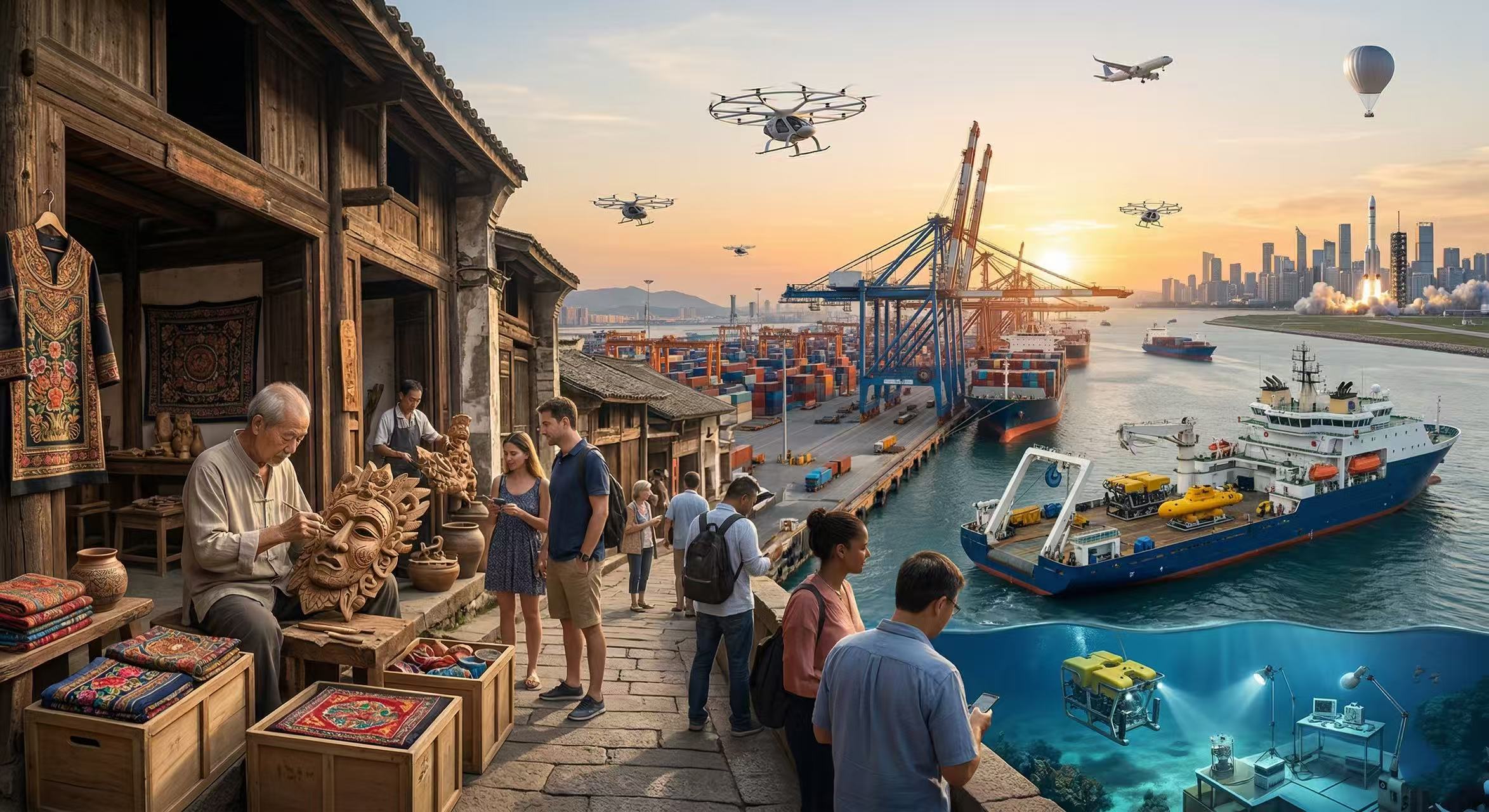
Within this highly compressed modern business cycle, the gaze of enterprise and capital is no longer confined to the flat, two-dimensional skirmish for market share; rather, it has begun to seek safe harbours and explosive growth catalysts across the extreme dimensions of time and space. To " look backward " manifests as society's collective retrospection towards cultural roots and historical sentiment; adrift in a highly uncertain hyper-modern society, consumers are attempting to transmute historical and emotional compensation into explosively lucrative commercial services and consumer goods. To " look forward " involves taking intangible cultural heritage—practices yet to be alienated by the modern industrial assembly line—and deploying them as high-end instruments of "cultural arbitrage," reverse-exporting them to a global market suffering from severe industrial product fatigue. To "look upward" reveals commercial aerospace and the low-altitude economy fracturing the physical boundaries of Earth at an astonishing velocity; the zero-gravity orbital sphere and the sub-100-metre low-altitude network are rapidly transitioning from experimental laboratories to normalised commercial infrastructure. Finally, to "look downward" is to recognise that the abyssal depths of the ten-thousand-metre ocean have been validated by the scientific establishment as a colossal "blue pharmacy" and a reservoir for new energy, sounding the commercial prelude to a chemosynthetic biosphere.
Simultaneously, the attention of the world is pivoting towards China with an unprecedented posture. Amidst this high-stakes game of geopolitical and economic paradigm shifts, capital from the Global South and sovereign wealth funds from the Middle East are pouring into China's capital markets and its hard-technology hinterlands with an acutely strategic stance, attempting to forge an underlying connectivity free from the constraints of the Western financial apparatus. Concurrently, the regionalised settlement of the renminbi (RMB) is breaching historical thresholds, fundamentally rewiring the global trade settlement network.
This instalment of The Weekly Opportunity Hunter will serve as your radar for navigating this complex system. By conducting a deep decoding of the week's most representative specific commodities, underlying capital flows, and frontier cultural lexicon, we will uncover the authentic commercial logic driving this "space-time arbitrage," assisting you in piercing through the deafening noise of the information age to anchor investment opportunities that possess long-cycle compounding value.
Signal Capture: Real-Time Information and Emotional Arbitrage
In the commercial vernacular of 2026, to persist in understanding a "commodity" merely as a standardised item sitting on an Amazon digital shelf, or as a mass-manufactured trinket weighed by the kilogram in the wholesale markets of Yiwu, is to hold a cognitive framework hopelessly outpaced by the times. In the Chinese market this week, the ontological definition of the commodity has been radically broadened: it is now a costume drama bearing the emotional compensation of tens of millions of viewers; it is an artificial intelligence algorithm designed to soothe the pain of bereavement during the Qingming Festival; it is a highly pure protein crystal cultured aboard a space station; and it is a novel extremophile gene sequence extracted from ten thousand metres beneath the sea.
Product Hunter: Multidimensional Value Export and Psychological Mapping
Looking Backward: The Commodification of Emotion and the Dark Blue Ocean of "Grief Tech"
As the economic utility of the physical world is increasingly commoditised—and frequently rendered entirely free—by generative artificial intelligence and hyper-competitive efficiency tools, the modern consumer market is undergoing a fundamental revolution in its underlying motivations. Consumer behaviour is experiencing a systemic shift from traditional "utilitarian acquisition" to an "emotional regulatory mechanism". This transition has been vividly manifested in this week's entertainment and ritual consumption, coalescing into a magnificent display of psychological escapism and emotional compensation.


The cultural and entertainment industry has historically functioned as a barometer for mass social sentiment, but today, it operates more akin to a highly standardised Software-as-a-Service (SaaS) product for emotional delivery. In early April 2026, the explosive data surrounding the costume fantasy romance drama Veil of Shadows (Yue Lin Qi Ji) provides a textbook commercial sample of this trend. Following its exclusive premiere on Youku, the series required a mere 52 hours to shatter the 10,000-point barrier on the platform's heat index, directly setting the record as the fastest drama to do so in 2026. As the series gained momentum, its market share according to Yunhe Data skyrocketed to 17.9% by its fifth day of broadcast; boasting a single-day playback volume exceeding 38.5 million views, it secured Yunhe Data's highest possible rating of S+.

This phenomenal level of heat is emphatically not an accidental monetisation of internet traffic, but rather an outcome predicated upon meticulous "emotional engineering" and extreme industrialised production. Analysed through a deep commercial lens, its success rests upon several irreplicable core pillars. The primary driver is the visual premium generated by an extreme commitment to industrial aesthetics. The director deployed a massive budget of 300 million RMB to construct a grandiose visual universe; a single costume in the production featured 3,000 hand-embedded scales, while the special effects budget reached a staggering 80,000 RMB per minute. This disregard for cost constraints precisely addresses the modern audience's acute hunger for high-quality cinematic industrial aesthetics, with viewers overwhelmingly validating the series' "exquisite costume and set design" in their feedback.

Secondly, the production employs high-concept narrative settings to forcefully dilute the existential anxiety of modern urbanites. The script seamlessly integrates hard sci-fi tropes such as "parallel universes" and "infinite loops" into its fantasy framework; notably, in the "Shangxu Shayuan" narrative arc, three sets of characters enter parallel timelines with entirely divergent flows of time: for some, 50 arduous years pass, while others experience a mere 12 hours. This dramatic manipulation of temporal flow essentially provides an immensely attractive psychological refuge for a modern metropolitan populace suffering from severe "time poverty" in a high-pressure, fast-paced society. Finally, the cultural momentum embedded within the series grants it formidable cross-border export capabilities. The drama did not merely dominate domestic charts, but surged to the number one position on Youku Indonesia, while its topic views on TikTok across Southeast Asia rapidly eclipsed 230 million. This profoundly demonstrates that character bonds steeped in Eastern philosophical reflections and high emotional density (such as the series' dual-heroine redemption arc that disrupts conventional female rivalry tropes and explores the "uncertainty of memory") possess global commercial liquidity capable of traversing geopolitical and cultural barriers.
|
Veil of Shadows Commercial Metrics |
Core Performance (April 2026) |
Industry Impact and Trend Extrapolation |
|
Explosive Velocity & Platform Record |
Surpassed Youku heat index of 10,000 within 52 hours of premiere. |
Shatters the endemic issue of narrative dragging in long-form dramas. |
|
Market Share & Traffic Volume |
Single-day playback exceeded 38.5 million views. |
Proves the exceptional user stickiness and monetisation potential of high-emotion-value content. |
|
Industrial Input Cost |
Total investment of 300 million RMB; special effects cost 80,000 RMB per minute. |
Drastically raises barriers to entry in film industrialisation, eliminating low-end production capacity. |
|
Overseas Expansion & Cultural Export |
TikTok SE Asia views exceeded 230 million; topped Youku Indonesia. |
Achieves high-quality reverse cultural export of Eastern fantasy aesthetics. |

If costume dramas represent a romanticised reconstruction and emotional anchoring of a bygone era, the sudden prominence of "grief tech" during this week's Qingming Festival illustrates the deployment of the most cutting-edge, clinical technology to soothe humanity's most ancient forms of loss and mourning. During the 2026 Qingming holiday, the Chinese market presented a consumer spectacle that was imbued with a cyberpunk paradox, yet it remained entirely logically self-consistent.
According to publicly disclosed municipal data from Shenzhen in April 2026, the city received a staggering 3.216 million tourists over the three-day holiday, generating 2.12 billion RMB in tourism revenue, while high-end hotel bookings surged by 190% year-on-year. However, beneath the surface of this booming physical cultural tourism, a covert yet colossal digital emotional supply chain was frantically expanding across the hardware stalls of Huaqiangbei and within cloud server farms. During the holiday period, retail sales of AI hardware in Shenzhen's Huaqiangbei commercial district spiked by 50% compared to typical days; devices such as AI translation machines supporting over 140 languages, smart glasses, and robotic mobility aids for the elderly emerged as absolute bestsellers.
In the more traditional domain of ancestral rites, technology is quietly assuming control of the living's mourning processes. Shenzhen's Yoshida Cemetery and Nanshan District's Bao'en Fudi Cemetery have normalised the installation of exoskeleton robot and stair-climbing robot experience stations, providing stable physical assistance for elderly individuals with limited mobility, thereby entirely resolving the physical difficulties associated with ascending to grave sites. Concurrently, the "Cloud Memorial Hall" established by Shenzhen's smart funeral system has realised ecological burial and digital immortality in the truest sense; family members can log into a deceased relative's exclusive space at any time to mourn within a digital matrix preserving biographical videos and life stories, achieving an "unhindered love" that transcends physical geography.