Issue Date: March 16, 2026 – March 22, 2026
Keywords:East Rising, West Falling; Dual Circulation; Global South; Factory Heirs
Weekly Message:
To observe the global macroeconomic narrative in the third week of March 2026 is to experience a profound and jarring cognitive dissonance. Consumers of the traditional Western financial press might reasonably assume that China’s economic engine is stalling—throttled by a deflationary property sector, a languid domestic consumer base, and the aggressive architecture of three-digit tariffs.
Yet, the raw customs data released this week utterly shatters this comfortable illusion. In the first two months of 2026, the total value of China's trade in goods surged by a staggering 18.3% year-on-year, reaching 7.73 trillion yuan (approximately $1.12 trillion). Within this aggregate, exports exploded by 19.2% to 4.62 trillion yuan, while imports climbed 17.1% to 3.11 trillion yuan.
This is no ephemeral "dead-cat bounce," nor is it a statistical anomaly born of a low base effect; rather, it is the roar of the world’s most formidable industrial base executing a rapid, violent, and highly successful structural pivot.

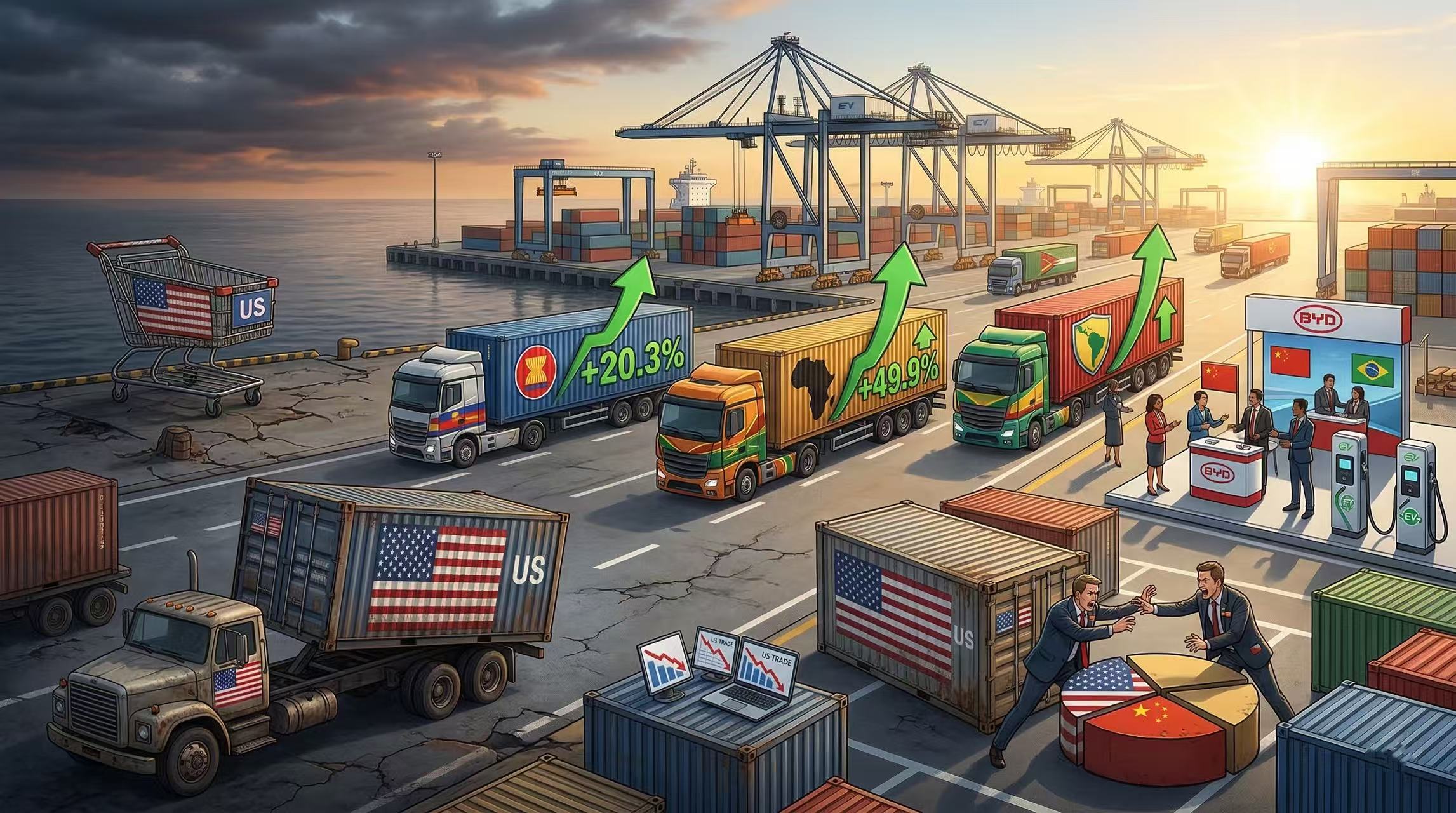
The undercurrents of these figures reveal a monumental geographical and structural realignment. Bilateral trade with the United States fell by 16.9%—the direct and entirely predictable consequence of high-tariff frictions and geopolitical posturing. Yet, this vacuum has been filled instantaneously and aggressively: exports to the Association of Southeast Asian Nations (ASEAN) surged by 20.3%, combined trade with Belt and Road Initiative (BRI) countries grew by 20%, and exports to the African continent skyrocketed by an astonishing 49.9%. China has long since outgrown its reliance on the American consumer to keep its factory floors humming.
The core framework for decoding this week's signals relies upon our trusted methodology: the "Time Machine Theory". This concept posits that the micro-innovations, capital flows, supply-chain migrations, and cultural shifts occurring within China today serve as a crystal ball for global market dynamics six to eighteen months hence. Our study of China is neither an academic exercise nor a grand geopolitical simulation. Our singular commercial research objective is information arbitrage. Our purpose is to capture the micro-signals flickering across Shenzhen, Shanghai, and Kunming this week and translate them into actionable strategies for global Software-as-a-Service (SaaS) founders, Amazon FBA operators, independent developers (Indie Hackers), content creators, and macroeconomic investors.
The structural shifts evident between March 16th and 22nd, 2026, indicate that the window for traditional cross-border retail is slamming shut; concurrently, explosive opportunities are emerging in infrastructure, software services, and community curation.
This week’s commercial intelligence is anchored to three foundational market movements:
- The Ecosystem Export: Chinese manufacturing is no longer merely exporting cheap, white-label plastic consumables to the West; it is directly exporting highly vertically integrated, high-tech ecosystems and electric mobility hardware to the "Global South".
- The Silicon Defiance: Squeezed by semiconductor export controls and Western technology embargoes, China is successfully localising advanced computational manufacturing, which will permanently alter the global hardware and AI supply chains.
- The Heirloom Pivot: Highly educated, digitally native "factory heirs" are seizing control of traditional manufacturing bases, systematically dismantling the traditional "middleman model" upon which Western e-commerce operators have relied for the past decade.
For the astute and time-poor operator, the perpetual question must be: Where is the signal? And where is the arbitrage space?
The Product Hunter
Focus: "What is selling?"
The most potent signals of macroeconomic realignment are frequently hidden inside shipping containers. The era of dropshipping low-value novelties to Western shores via AliExpress is rapidly drawing to a close. In its place is a sophisticated, dual-pronged global strategy: deploying complex hardware ecosystems to emerging markets, while simultaneously executing precision strikes on Western consumers via D2C (direct-to-consumer) social commerce.
Signal 1: The "Boda Boda" Battery Arbitrage Network
The African continent is currently undergoing a two-wheeler transport revolution, and the hardware driving this paradigm shift overwhelmingly originates from Chinese industrial hubs such as Chongqing. In Kenya, motorcycle taxis known as "boda bodas" form the absolute backbone of urban logistics and mobility; by the end of 2025, electric motorcycles had captured 15.3% of all new vehicle registrations.
The data crystallising this week is staggering in its scale. Zongshen, a manufacturing titan headquartered in Chongqing, reported that its global motorcycle exports surpassed five million units, with a vast proportion flowing directly into African nations. However, the true arbitrage opportunity does not lie in the hardware itself—the commoditisation of frames and motors is hyper-competitive—but rather in the infrastructure required to keep them moving: battery-swapping networks.
Startups operating in this vertical are attracting massive capital. Spiro recently closed a $100 million funding round, led by the African Export-Import Bank's Fund for Export Development in Africa, and now operates over 80,000 electric motorcycles across the continent, equipped with 2,500 battery-swapping stations. Companies such as Fika Mobility and Roam Electric are also aggressively leveraging Chinese supply chains to provide motorcycles with hot-swappable lithium batteries.

The unit economics for the end-user are irrefutable. Kenyan boda boda riders historically spent between 40% and 60% of their gross daily income on petrol. By transitioning to electric models paired with battery subscription services, their daily energy costs plummet by up to 75%.
Cultural Context: Why is this exploding now? Volatile global oil prices, depreciating emerging market currencies, and the sudden availability of ultra-low-cost, highly durable Chinese electric vehicle components have catalysed a perfect storm. African logistics demand robust, low-cost solutions, and Chinese manufacturers have cornered the ecological niche by providing "good enough" technology at unmatchable price points.
Cross-border Strategy (The Arbitrage): Chinese manufacturers exhibit supreme dominance in hardware unit economics, producing durable frames and high-density batteries at prices the West cannot replicate. Yet, these massive industrial entities have historically faltered in localised software integration and user experience.
For Western independent developers, SaaS founders, and fintech operators, the arbitrage space exists entirely within the software layer of the African e-mobility boom. The market is in extreme and desperate need of localised battery-swap management APIs, micro-finance algorithms that assess credit for everyday riders lacking traditional credit scores, and last-mile routing software optimised for these specific EV fleets. China has deployed and heavily subsidised the hardware; the software ecosystem required to connect, manage, and commercially monetise it remains a vast blue ocean.
Signal 2: The Deluge of Factory-Direct Sales on TikTok
Over the past year, Western social media platforms (particularly TikTok) have experienced an unprecedented flood of "direct-to-consumer" marketing from Chinese factory owners, who explicitly urge shoppers to disregard the punitive tariffs mercilessly levied upon them. In viral videos, representatives claiming to be original equipment manufacturers (OEMs) for major luxury and athletic brands offer premium goods for a fraction of their retail price.