Issue Date: January 19,2026 – January 25, 2026
Keywords: The viral cycle of the "Crying Horse", the "Still Alive?" app controversy, Beijing's mega M&A fund, and the rise of the "Silvercore" aesthetic.
Weekly Message
Intercept viral consumer assets within China's digital ecosystem before they penetrate Western social media. We are hunting for products that possess high transmission velocity, high emotional value, and the ability to bridge the cultural divide between the East and the West. The current window (Jan 19-26) offers a masterclass in "emotional arbitrage"—the success of these products lies not in their utility, but in their validation of a specific, ineffable cultural pain point.
1. Product Hunter
1.1 Crying Horse
- Status: Viral explosion (Yiwu supply chain nearing saturation).
- Origin: Yiwu International Trade Market / Xiaohongshu (Little Red Book).
- Western Equivalent: "Sad Hamster" meets Squishmallows, but presented as an industrialized version tailor-made for corporate burnout.
|
Product Metrics |
Data Points |
|
Chinese Name |
Crying Horse (Ku Ku Ma) |
|
Daily Sales |
~15,000 units (data from a single factory) |
|
Core Platforms |
Xiaohongshu (Seeding/Discovery) -> Taobao/Pinduoduo (Conversion) |
|
Primary Demographic |
Gen Z corporate workers suffering from severe "Ban-wei" (the stench of work) |
|
Key Feature |
"Intentional Defect" (inverted mouth stitching) |
The Signal
In the highly seasonal world of Chinese e-commerce, the weeks preceding the Lunar New Year are typically dominated by aggressive optimism. The upcoming Year of the Horse, beginning on February 17, 2026, should theoretically be flooded with symbols of vitality, speed, and the "dragon-horse spirit" (vigorous and energetic). However, this week's smash hit is the antithesis of this tradition.
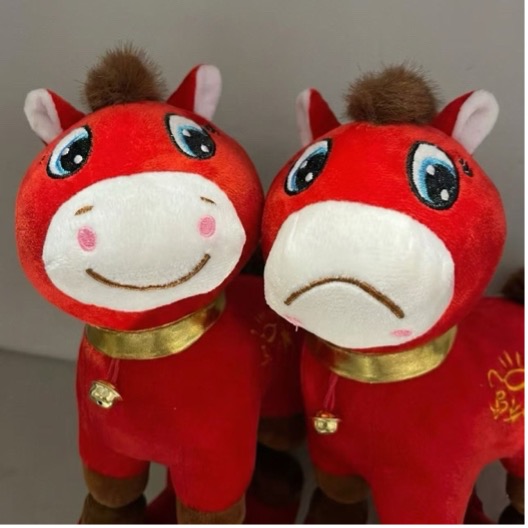
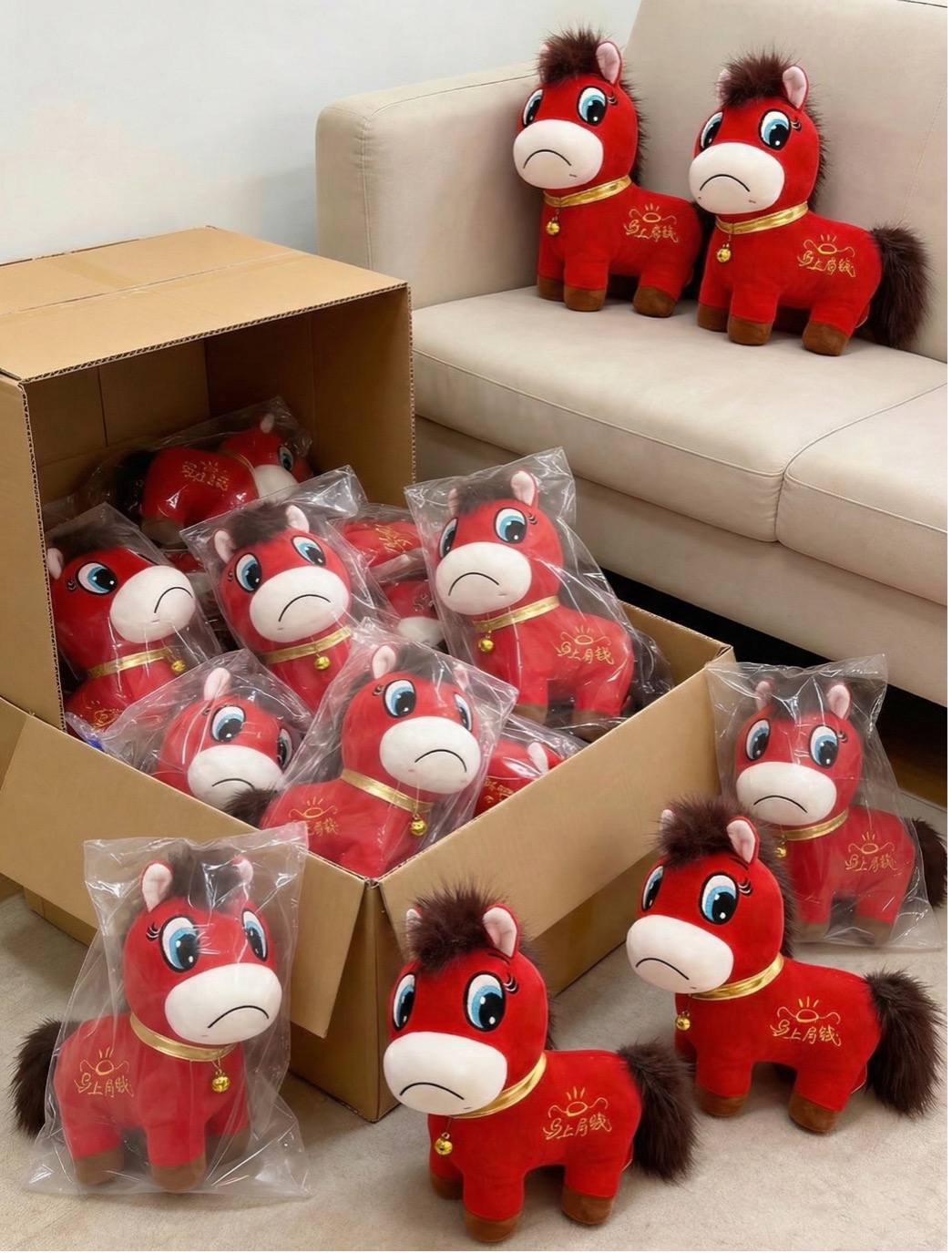
The "Crying Horse" is a red plush toy, roughly 20-30 cm tall, originally designed to convey the auspicious meaning of "instant wealth on horseback." Yet, in mid-January, a manufacturing error on a Yiwu production line resulted in the horse's mouth being sewn upside down. Instead of a protruding smile, the horse bore a sunken, concave, miserable expression. The eyes, originally designed to look docile, appeared in this context to be averting their gaze in shame or exhaustion.
A batch of these "defective" products was shipped to a customer who, rather than returning it, filmed a video and posted it on Xiaohongshu with the caption: "This horse looks exactly like me at 3 PM on a Tuesday." This post struck a nerve in the Chinese digital psyche, triggering a viral feedback loop that transformed a quality control failure into this week's most coveted asset.
The Velocity The speed at which this product went from "reject" to "category champion" demonstrates the ferocity of the Yiwu supply chain.
- Week of Jan 12: The initial viral post appeared.
- Jan 19-26: The trend exploded. The "Crying Horse" dominated search queries on Douyin (TikTok China) and Taobao.
- Supply Chain Response: Factory owner Zhang Huoqing initially offered a refund. However, upon seeing the traffic, she refused to fix the machines. Instead, she retrofitted ten additional production lines to intentionally manufacture this defect. Daily production skyrocketed from 400 to over 15,000 units within 48 hours.
- Current Status: The "happy" horses are sitting unsold in warehouses; the "crying" horses are sold out on pre-order, and international orders from Russia and Southeast Asia are pouring in.
The "Why" (Time Machine Logic)
Western observers often mistake China's "Sang culture" (a subculture of demotivation and apathy) for simple depression. It is not. It is performative compliance and surrender. The Crying Horse resonates because it captures "Ban-wei" (see Lexicon Decoder below)—that specific, soul-crushing "stench" of the corporate workplace.
- Visual Language: The "ugly-cute" aesthetic is a dominant force in Gen Z consumption. Following the 2025 success of the teeth-baring, chaotic-style Labubu dolls, the Crying Horse provides emotional validation. It is not cute because it is perfect; it is cute because it is broken.
- Subversion of Tradition: Traditional Lunar New Year gifts are oppressive in their optimism—red and gold color schemes, wealth, power, and energy. For a stagnating generation facing record-high youth unemployment, these symbols feel like a mockery. The Crying Horse subverts this pressure. It allows buyers to participate in the holiday while ironically distancing themselves from the expectations of success. It says: "I am present, but I am not okay, and that is hilarious."
Cross-Border Arbitrage & Actionable Guide
For Dropshippers and content commerce sellers, this is a Level 5 (highest tier) opportunity. Western markets are primed for this. The "Sad Hamster" meme (paired with violin music) on TikTok US/UK proves that the "pathetic aesthetic" is highly viral. The "Crying Horse" is the physical embodiment of that meme.
- Angle of Entry: Do not sell this as a Lunar New Year toy. The cultural context of the zodiac is useless noise to a general Western audience. Sell it as "The Corporate Burnout Buddy" or "The Monday Morning Mascot." The narrative logic for TikTok Shop is highly straightforward: "The only coworker who actually gets you."
- Target Audience: Remote workers, corporate Gen Z, and the "Bed Rotting" community.
- Sourcing Strategy: Search the Yiwu industrial belt via AliExpress or private agents using keywords like "Cry Horse," "Sad Red Horse," or "Ku Ku Ma."
- Key Risk: Ensure you are sourcing the intentional defect version. Manufacturers are currently scrambling to alter "happy" inventory to look sad, but that specific "inverted stitching" is the visual key. The "happy" versions are worthless inventory.
- Logistics: Plush toys are a dimensional weight nightmare. Ensure you use vacuum sealing to lower shipping costs, but be wary of permanent deformation.
- Platform Playbooks:
- TikTok: Use the Sad Hamster violin soundtrack. Show the horse "working" in front of a laptop, "crying" over an Excel spreadsheet.
- Etsy/Shopify: Bundle sales with "anti-hustle/anti-resilience" quotes. The keyword "Sad Animal Apparel" is already starting to gain traction on Etsy.
1.2 "Still Alive?" APP (Demumu)
- Status: Chart Topper (Paid Utilities).
- Origin: Zhengzhou (Moonscape Technologies).
- Western Equivalent: "Life360" stripped of all features except the death check.

|
App Overview |
Details |
|
Original Name |
Still Alive? (Si le me) |
|
Global Name |
Demumu |
|
Price |
~8 RMB ($1.15 USD) |
|
Core Mechanism |
Dead Man's Switch: Daily check-in, or else it alerts emergency contacts. |
|
Developer |
Moonscape Technologies (Zhengzhou, China) |
The Signal
An app originally named Still Alive? (literally: "Are you dead yet?") topped the Chinese paid download charts this week, surpassing essential utility apps. The app has a single, brutal function: it prompts the user to check in once a day (or every 48 hours). If the user fails to tap the button, it automatically sends an email to preset emergency contacts ("legacy contacts"), alerting them that something may have happened.
After sparking fierce controversy on Weibo regarding its morbid name (many users considered it inauspicious or "cursed"), the developers rebranded the global version as Demumu, and the domestic version was also given a milder name. Despite the controversy—or perhaps because of it—it currently ranks in the top 2 for paid utilities in the US, Singapore, and Hong Kong, and in the top 4 in Australia and Spain.
The Velocity
- User Base: Initially targeted at the elderly to prevent Kodokushi (lonely deaths), the user base has since been taken over by young, urban solo dwellers (ages 20-35).
- Revenue Model: The app transitioned from free to a paid model at 8 RMB ($1.15 USD). The conversion rate remains astonishingly high, proving that the price of "survival security" is inelastic.
- Viral Driver: The anxiety of "living alone." As marriage rates plummet, single-person households are projected to reach 200 million by 2030; this app has productized the fear of "dying alone and unnoticed."
The "Why" (Time Machine Logic)
This is The Atomization Economy. China is 6-18 months ahead of the West in normalizing extreme youth social isolation.
- Insight: Western safety apps (Life360, Citizen) are built on surveillance and active family networks. Demumu is built on absence and isolation. It assumes no one is watching you. It automates the "wellness check" because the social fabric has frayed to the point where no one will do it manually. This deeply resonates with the "loneliness epidemic" narrative currently peaking in the US and UK.
- The Privacy Paradox: Unlike Life360, which tracks real-time location, Demumu claims to collect zero location data. It only knows whether you are still active. This "low-fidelity security" appeals to a generation skeptical of surveillance capitalism but terrified of being forgotten.
Cross-Border Arbitrage & Actionable Guide