Issue Date: May 18, 2026 - May 24, 2026
Key words: Scandal, Micro-Drama Marketing, Virtual Persona, Agile Marketing, Asymmetric Warfare, Algorithmic Recommendations, Gossip Traffic, Traffic Conversions, Emotional Value, Moral Compensation Psychology, Unvarnished Authenticity, Traditionalism & Firm Ethical Baseline
Weekly Message:
In China’s consumer market of May 2026, observers witnessed a black swan event that felt both surreal and deeply revealing. A single towel—priced at little more than a dozen yuan and designed for one of the simplest functions in daily life—somehow transcended its physical identity. It became a catalyst for nationwide online traffic, reshaped brand perceptions, and unexpectedly evolved into a public conversation about family ethics and moral values.
Over the course of fewer than ten chaotic days, Grace (Jieliya), a longtime giant in China’s home-textile industry, was pulled into a spiraling public scandal triggered by nothing more than a family group photo released during its 40th-anniversary celebrations. The company became the subject of relentless frame-by-frame scrutiny across the internet, eventually taking the extraordinary step of reporting the matter to public security authorities and publishing DNA paternity test results in an attempt to clear its name.

Forming an utterly absurd yet stark contrast was a mid-sized industry peer from Shandong Province named Maomaoyu. During a routine e-commerce livestream, its founder was subjected to an unprovoked barrage of "misplaced cyberbullying" from furious netizens. However, by producing a yellowed, vintage 1974 marriage certificate on stream, paired with a broadcasting assistant’s brilliantly improvised quip about being the "no-mistress, original-wife edition," the company successfully absorbed the colossal overspill of "gossip traffic" haemorrhaging from its embattled rival. This stroke of genius not only defused the crisis but engineered a commercial miracle, multiplying single-day sales by a factor of one hundred within a mere forty-eight hours.

As one netizen astutely observed on a social media platform, the prevailing sentiment shifted: selling towels was once considered mere physical labour; it is now apparent that it requires physical stamina, theatrical acting, and ultimately, masterful public relations. The quip that "this industry is simply too punishing; the towel just wants to quietly wipe a face in peace" precisely encapsulates the profound mutation in the competitive logic of the contemporary consumer goods market. This is no longer a conventional commercial skirmish fought over fabric weight, water absorbency, pure cotton materials, or supply chain efficiencies. Instead, it has morphed into a "high-dimensional strike" orchestrated entirely by algorithmic recommendations, fuelled by emotional resonance, and inextricably woven with the culture of micro-dramas and mass moral judgements.
This edition of The Niche Hunter anchors its analytical window between May 18 and May 24, 2026, to provide a panoramic retrospective of this traffic backlash and the ensuing asymmetric carnival within the towel industry. By piercing through the cacophony of gossip, the analysis dissects the origins of the Grace crisis, deconstructs Maomaoyu's traffic conversion pathways, and contrasts these with the strategic choices of traditional giants like Sunvim Group (Furier). This offers high-net-worth commercial decision-makers a revelation: in a fragmented era dominated by "emotional value," traditional brick-and-mortar enterprises must navigate both the gifts and the poisons of digital traffic, recognising the fragility of brand equity under the public gaze and the necessary pathways for its reconstruction.
I. The Backlash of Traffic: The Folding of Virtual and Real Realities in a 40 Billion Yuan 'Towel Empire'
To comprehensively grasp the destructive magnitude of this public opinion firestorm and its underlying structural logic, it is intellectually necessary to rewind the chronological clock. One must painstakingly dissect the specific "persona" that Grace, a venerated legacy enterprise, meticulously engineered within the collective consciousness of the consumer public, and crucially, how this artificial projection ultimately clashed with the obscured realities of its actual dynastic governance structure, precipitating a fatal misalignment. The historical trajectory of Grace is, in its essence, a highly concentrated microcosm of the relentless struggle and subsequent transformation of rural, privately-owned Chinese manufacturing enterprises. Its contemporary crisis serves as a brutal cautionary tale detailing the exorbitant price traditional manufacturers pay when they aggressively court new-media traffic without a disciplined respect for corporate boundaries.
1. The Generational Leap: From OEM Workshop to National Home Textile Brand
The commercial genesis of the Grace empire is saturated with the grassroots resilience and pragmatic ethos characteristic of the first generation of Zhejiang entrepreneurs. In 1986, the patriarch and founder, Shi Changjia, assumed management of a diminutive, collectively-owned operation known as the Zhuji County Towel Factory in Zhejiang Province. By 1994, navigating a period where the factory was teetering on the precipice of insolvency and suffocating under the weight of insurmountable debt, Shi Changjia executed a daring financial manoeuvre. Leveraging his personal real estate as collateral, he secured a loan of 4.57 million RMB to execute a full buyout, effectively transitioning the enterprise from a collective ownership model into a fiercely independent private corporation. In that specific historical epoch, the domestic market for daily consumer goods in China was characterised by a relative scarcity of material supplies, perpetually operating in a state where demand vastly outstripped available supply. Under Shi Changjia's stewardship, the factory stabilised its foundational operations through Business-to-Business (B2B) channels, functioning primarily as an Original Equipment Manufacturer (OEM) executing white-label production for formidable state-owned enterprises localised in metropolitan hubs such as Shanghai and Hangzhou. However, the OEM model is notoriously unforgiving; profit margins were razor-thin, and the factory languished at the absolute bottom of the industrial value chain, wholly devoid of pricing power or strategic leverage. Possessing an acute commercial intuition, Shi Changjia recognised this existential threat and, upon securing the company's financial bedrock, initiated a relentless ascent toward the more lucrative upper echelons of the value chain.
The year 1996 marked a watershed moment with the formal registration of the "Grace" trademark, signalling the enterprise's perilous but necessary leap from subservient OEM dependency to autonomous brand operations. As the calendar turned to the 21st century, the domestic corporate consciousness regarding brand marketing was only in its nascent stages of awakening, with the overwhelming majority of traditional manufacturing entities remaining deeply entrenched in a conservative paradigm that prioritised physical production whilst systematically undervaluing public relations. It was against this backdrop that Shi Changjia's eldest son, Shi Lei, resigned from a secure public service position to return home and assume the mantle of leadership, inaugurating the golden epoch of Grace's brand expansion. Shi Lei demonstrated an audacious level of commercial courage. Around the year 2006, facing a total annual corporate revenue of approximately 96 million RMB, he greenlit an astonishing capital expenditure of 70 million RMB in hard currency to finance a mammoth brand-building crusade. The enterprise aggressively retained the prominent actress Xu Jinglei as its official brand ambassador and secured highly coveted, prime-time advertising slots on China Central Television (CCTV), subjecting the nation to a high-density, saturation-level advertising bombardment. The deeply resonant advertising slogans, asserting that "Life requires Grace" and "Towels must be Grace," not only entrenched themselves as the collective memory of an entire generation of Chinese consumers but rapidly widened the competitive chasm between Grace and its mid-tier rivals, successfully elevating the company into the absolute highest echelon of the domestic home textile industry.
By the time Shi Lei assumed comprehensive operational control of the conglomerate in 2010, Grace's annual revenues had triumphantly breached the 1 billion RMB threshold, and the corporation began a methodical expansion into a comprehensive suite of home furnishing categories. Fast forward to May 10, 2026, and Grace proudly trumpeted that its cumulative brand value had skyrocketed to a staggering 44.31 billion RMB, retaining its undisputed crown as the preeminent brand in the Chinese home textile industry for an unprecedented thirteen consecutive years, representing a robust year-on-year growth of over 4 billion RMB compared to 2025 metrics.
Yet, the inherent brutality of the commercial universe dictates that no single operational model grants eternal invulnerability. With the comprehensive explosion of the mobile internet era and the relentless downward penetration of decentralised e-commerce channels, the domestic home textile and daily commodities sector abruptly departed its era of aggressive, volume-driven expansion, entering a gruelling, zero-sum cycle of stagnant inventory competition. The aggressive proliferation of disposable substitutes—most notably, single-use facial cleansing towels—began systematically cannibalising the market share historically dominated by traditional woven cotton towels.
Grace had historically relied with immense disproportion on a vast, terrestrial network of offline distributors, with over 90% of its sales volume tethered to traditional channels, exposing the brand to the dual existential threats of brand ageing and a severe demographic disconnect with younger consumer cohorts. In 2016, Shi Changjia's second son, Shi Jing—armed with a master's degree from the prestigious University of Manchester—returned to China to architect a dedicated e-commerce division. Spearheading a rejuvenation initiative in 2017, Shi Jing orchestrated a series of cross-boundary intellectual property (IP) collaborations by 2019, partnering with internationally recognised franchises such as LINE FRIENDS and the Minions in an attempt to shatter the brand's demographic ceiling. However, the profound dissonance between the consumption scenarios of Grace's traditional offline consumer base and the youthful demographics targeted by the IPs resulted in commercial outcomes that fell drastically short of expectations; the brand's penetration into the elusive youth market remained stubbornly inadequate.
2. The Honey and Poison of Micro-Drama Marketing: The Loss of Control Over a Virtual Persona
The catalyst that ultimately propelled Grace back into the glaring spotlight of mainstream public consciousness—and did so with an aggressively youthful, hyper-digitised posture—was Shi Lei's eldest son, universally dubbed the "third-generation corporate heir," Shi Zhancheng. Having graduated from the esteemed acting programme at the Communication University of China, this young man chose to return to the familial corporate fold following a series of unsuccessful independent entrepreneurial ventures. Acting on the strategic counsel of his father, he resolved to leverage his formal, academic training in the dramatic arts. By harnessing the explosive, contemporary format of serialised micro-dramas, he sought to excavate a novel, highly lucrative avenue for algorithmic traffic to revitalise the legacy brand.
In February 2024, operating through his personal short-video broadcasting account appropriately monikered "Towel Young Master," Shi Zhancheng premiered a self-written, self-directed, and self-starring serialised short drama entitled The Towel Empire. This production demonstrated an exceptionally acute sensitivity to modern content consumption patterns. It completely eschewed the archaic, direct-sales promotional methodologies of the past; instead, it ingeniously weaponised the authentic, real-world dynastic backdrop of the Grace corporate family, utilising it as the fertile narrative soil to cultivate a highly sensationalised, fictitious saga of "aristocratic corporate infighting".
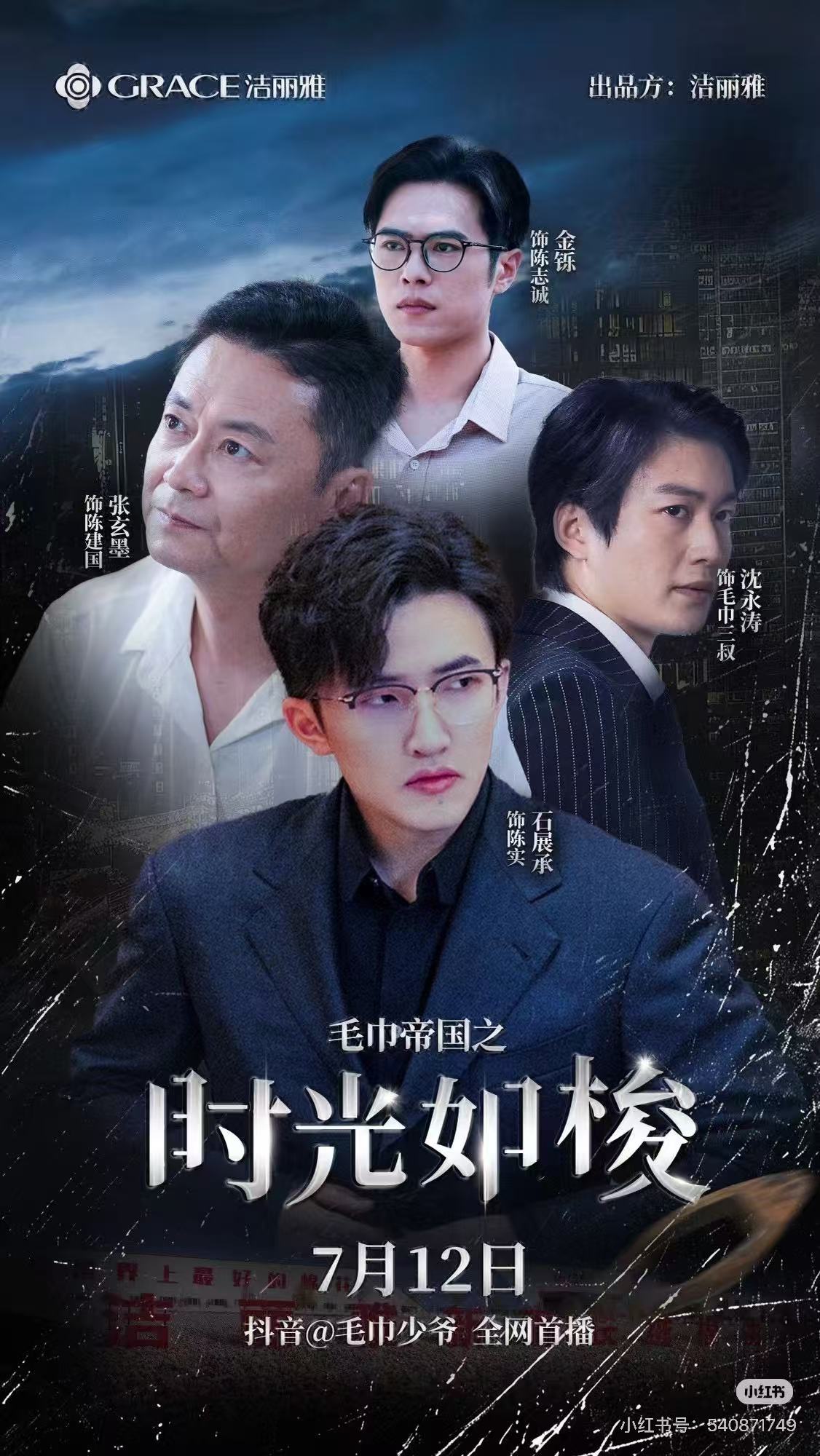
Within the theatrical confines of the narrative, Shi Zhancheng meticulously tailored a highly sympathetic, ironically endearing persona for himself: the marginalised, "useless legitimate grandson." His viral monologue—"A perpetually busy grandfather, an award-winning father, a villainous uncle, and an entirely idle me"—ignited across the digital landscape. The plotlines were heavily saturated with the intoxicating tropes of pulp-fiction power struggles: vicious battles for corporate inheritance, the systematic marginalisation of the legitimate heir, and high-stakes boardroom coups. For instance, the script introduced a "Machiavellian" second uncle returning from the United Kingdom. Driven by a ruthless ambition to seize the corporate throne, this antagonist mercilessly banished the protagonist—ostensibly the CEO of the conglomerate—to perform gruelling manual labour at a foundational manufacturing plant in Xinjiang, allowing him to return to corporate headquarters only after three arduous years of exile to initiate a spectacular war of succession. In a startling convergence of reality and fiction, the role of this "villainous second uncle" was portrayed on-screen by none other than the actual, sitting President of the Grace Group, Shi Jing himself. This highly publicised, playfully antagonistic interaction between the genuine uncle and nephew expertly satiated the internet populace's insatiable, voyeuristic appetite for the cloistered lives of the ultra-wealthy.
The marketing dividends yielded by The Towel Empire were nothing short of phenomenal. Within a condensed three-month operational window, the cumulative cross-platform playback volume for merely seven published episodes obliterated the 120 million view threshold, while the subsequent second season rapidly amassed an additional 7.88 million views. This paradigm of ultra-low-cost content creation not only enabled a forty-year-old legacy domestic brand to successfully shatter its demographic boundaries but also precipitated an avalanche of traffic dividends and tangible commercial conversions. Capitalising upon the stratospheric popularity engineered by the short drama, Shi Zhancheng's inaugural livestream e-commerce broadcast magnetically attracted an audience of 2.43 million viewers. In a single session, sales breached the 5 million RMB mark, forcefully propelling him to the absolute zenith of the platform's commercial sales leaderboards. Grace moved swiftly to consolidate this momentum, officially registering trademarks such as "Towel Second Uncle," while Shi Jing aggressively expanded his public profile, making frequent appearances on televised variety programmes and serving as an apparel model for the brand, all in a calculated endeavour to transmute this torrential downpour of algorithmic traffic into immutable, deeply entrenched digital brand assets.
Evaluated strictly through the localised, quantitative lens of marketing return on investment (ROI), The Towel Empire was unequivocally a masterstroke. Simultaneously, however, it operated as a potent, slow-acting commercial poison. As astutely observed by veteran industry analysts: "If an enterprise intertwines its corporate destiny too intimately with an artificial influencer persona, it is tantamount to wagering the entirety of the company's future on an inherently volatile, probabilistic traffic casino". While the visceral thrill of the fictionalised narrative catalysed a tsunami of engagement, it concurrently—and perilously—obliterated the vital demarcation between theatrical fiction and commercial reality. Once the consumer public became conditioned to perceive this corporate entity primarily through the cynical, gossipy lens of entertainment, a proverbial Pandora's box of reputational risk was irreversibly unsealed.
3. The Collapse Triggered by a Photograph: Backstage Breakdown under Dramaturgical Theory
The detonation point of the ensuing crisis materialised in mid-May 2026. During a lavishly publicised ceremony celebrating Grace's 40th anniversary, a multi-generational family photograph, accompanied by fragmented video clips of the gala, was disseminated across major social media syndications. The original, corporate-approved intent behind this visual release was to project an aura of orderly dynastic succession and unimpeachable family harmony. However, filtered through the hyper-vigilant "short-drama mindset" of an audience conditioned to hunt for narrative easter eggs, the photograph was subjected to a brutal, frame-by-frame forensic analysis by the internet citizenry, ultimately metastasising into a nationwide moral inquisition.
The esteemed sociologist Erving Goffman, in his seminal treatise The Presentation of Self in Everyday Life, articulated the highly influential "Dramaturgical Theory". Goffman posited that all social interaction operates akin to a theatrical performance; individuals and institutions are perpetually engaged in efforts to construct an idealised image on the "front stage" that strictly conforms to societal expectations, whilst systematically concealing genuine, potentially contradictory behaviours and realities in the obscured "back stage". The serialised drama The Towel Empire functioned, in essence, as a highly sophisticated, meticulously choreographed "front stage" performance engineered by Grace. Viewers, engrossed in the narrative, forged a powerful "parasocial interaction" with the actor playing the "beleaguered young master", projecting their own deep-seated anxieties regarding workplace marginalisation onto his character, and subsequently transmuting that profound psychological empathy into direct purchasing power directed at the brand.
Tragically, the release of the 40th-anniversary photograph inadvertently, yet catastrophically, dragged the genuine, unvarnished "back stage" of the corporate family out from the shadows and thrust it under the blinding glare of public scrutiny. The audience was paralysed to discover that the authentic operational reality of the enterprise was vastly more cynical, complex, and unpalatable than the fictionalised drama.

The primary revelation concerned the brutal realities of the corporate power architecture. In the official anniversary photograph, Shi Zhancheng—ironically dubbed the "benched legitimate eldest grandson" by netizens—was positioned in a state of visible isolation on the absolute periphery of the frame, his facial expression betraying a palpable discomfort; conversely, the luminous, focal centre of the composition was monopolised entirely by the founding patriarch Shi Changjia, his second wife Zhang Xiaomei, and the purportedly "villainous" second uncle, Shi Jing. This visual evidence was rapidly corroborated by internet sleuths excavating public commercial registries and corporate filings, which revealed that while Shi Zhancheng's father, Shi Lei, retained the titular, honorific position of Chairman, the substantive, unyielding grip on operational power and executive decision-making resided entirely with Shi Jing, who served simultaneously as the legal representative and President of the conglomerate, despite being only six years senior to his nephew. In reality, Shi Zhancheng commanded only a microscopic, practically irrelevant fraction of equity in peripheral subsidiaries—a share directly equivalent to that of his younger half-sister—rendering him entirely ostracised from the conglomerate's central nexus of power. Consequently, the fictionalised narrative of the "exiled, useless young master" ceased to function as a humorous, self-deprecating meme; instead, it was violently reinterpreted by the public as a genuine lamentation regarding his absolute disenfranchisement.
Of significantly greater lethality, however, was the merciless excavation and malicious distortion of the family's matrimonial history and internal ethics. Unrelenting internet investigators uncovered that following a divorce from his first wife, patriarch Shi Changjia had married a woman named Zhang Xiaomei—a former corporate financial officer significantly his junior—with whom he fathered Shi Jing. Simultaneously, the eldest son, Shi Lei, had also endured a divorce and subsequently married a woman named Zhang Xiaoyan. Because the names of the two women differed by only a single character, the digital ecosystem acted as a hyper-accelerator for a devastatingly toxic and entirely unfounded rumour: the narrative rapidly took hold that "the father and son had married cousins or sisters", spawning sensationalised headlines screaming "Mother-in-law and daughter-in-law become sisters, father and son become brothers-in-law". The hysteria peaked with the proliferation of deeply damaging fabrications alleging that the sitting President, Shi Jing, was in fact an illegitimate child.